Pepi Super Stores: Fun & Games
- 4.1
- Rating
- 50.00M
- Installs
- Free
- Price

 Analysis by App-foxy
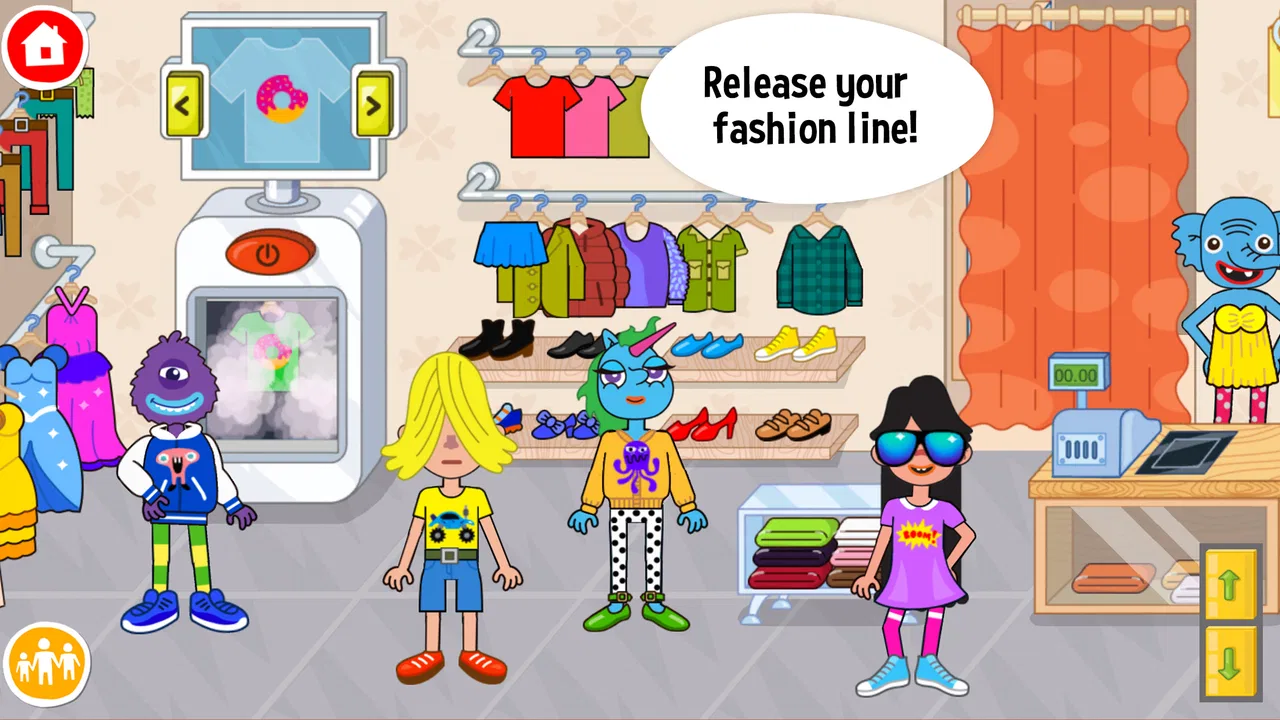
Some children’s games are built around a clear goal, while Pepi Super Stores: Fun & Games is more like a small digital playroom. I spent time moving through its colorful store setting, tapping objects, trying out character interactions, and watching how much freedom the game gives to make up little stories. That difference matters: the appeal is not winning a level, collecting a score, or completing a lesson in the usual sense. The appeal is deciding what happens next.
Developed by Pepi Play, this educational game is free to start and aimed at everyone. It has grown into a widely used children’s title, with over 50 million installs and an average rating of 4.1 from around 233 thousand ratings. Those figures suggest that the basic idea works for a large audience, but they do not answer the more important question for parents: will it still be interesting after the first week? My answer is yes, with an important qualification. It can remain useful as a creative toy, but it needs the right expectations and occasional adult involvement.
What the first week feels like
The first session is easy to understand because the environment communicates through pictures and touch rather than long instructions. A child can explore the store, pick up items, move them around, and experiment with the available characters and spaces. I found that the lack of pressure is immediately attractive. There is no need to read a complicated tutorial before playing, and a child who cannot read yet can still discover a lot through trial and error.
You May Also Like

 Blood Strike: 2.5 Anniversary
Blood Strike’s Loadouts Turn Every Drop Into a Tactical Gamble
A close look at Blood Strike’s custom loadouts: how fast access to signature weapons reshapes its battle royale rhythm, rewards preparation, and narrows the gap between fights.

 Pandora - Music & Podcasts
Pandora’s Music Is Easy to Start, but Harder to Recover
Pandora’s strength is its low-effort path from a seed to a station. Its weak spot is how much confidence it asks you to place in connection, setup, and quiet recovery.

 8 Ball Pool
 Is Built on Rivalries, Rematches, and Routine
A close look at the rivalries, rematches, shared routines, and unanswered safety questions that turn a quick pool match into a persistent mobile community.

 Samsung Music
’s Quiet Strength Is Playing What You Already Own
Its reach comes less from spectacle than from dependable access to a personal library. That simplicity is both the app’s strongest retention engine and its ceiling.

 AccuWeather: Weather Radar
AccuWeather Review: A Quick, Clear Forecast for Everyday Decisions
For everyday plans, the best forecast is the one you can understand quickly. AccuWeather makes rain timing, radar, and local conditions easy to act on, with a few trade-offs.

 Hill Climb Racing
Why Hill Climb Racing Still Turns Crashes Into One More Run
A tiny car, a bumpy hill and one more upgrade: Hill Climb Racing keeps resurfacing because its simple chaos makes every near-miss feel personal.
More From Our News Desk



That simplicity is one of the strongest design choices here. Instead of asking a young player to memorize rules, the game invites them to test cause and effect. Tap something, drag it somewhere else, give an item to a character, and see what happens. The result feels closer to pretend play with toys than to a traditional mobile game. The child supplies the story, while the game supplies the setting and props.
During the first few days, this creates plenty of small moments of discovery. A child might pretend to shop, prepare a meal, dress a character, or invent a family outing. The exact story is less important than the process of arranging people and objects. I especially liked that the game does not insist on one correct sequence. That makes it approachable for children with different interests and different levels of patience.
It is also a useful choice for short, informal play. If a child has ten minutes before leaving the house, there is no complicated campaign to resume and no penalty for stopping suddenly. The game can be opened, explored, and put away without demanding a long commitment. For parents, that makes it easier to use as a calm activity during a waiting period or while traveling.
That said, the first-week excitement can be misleading. A child who enjoys discovering every object may appear absorbed for a long time, but the novelty comes partly from testing the boundaries of the environment. Once the most obvious interactions have been tried, the game depends on whether the child enjoys inventing new scenarios. Children who prefer clear challenges may ask what they are supposed to do next. There is no conventional mission structure to provide that answer.
Why the pretend-play approach works
I think the game is at its best when an adult treats it as a prompt for conversation rather than a digital babysitter. Asking a child to create a shopping list, act out a birthday visit, or explain why a character is in a particular part of the store can turn simple tapping into language practice and social storytelling. The game does not need to announce a lesson to support those activities.
A realistic example is a child waiting at a café or in a doctor’s office. Instead of handing over a game designed around fast reactions, a parent can suggest a small story: one character needs to buy something, another has lost an item, and everyone has to get home before closing time. The child can use the store as a stage and then explain what happened. This works especially well for children who enjoy role-play but lose interest in worksheets.
There is a useful trade-off here. Because the game leaves room for imagination, it can encourage more original play than a title that simply presents matching questions or fixed puzzles. On the other hand, the learning outcome is less predictable. A child may practice vocabulary, sequencing, and social ideas, but the game does not replace a structured educational app when a parent wants a specific skill taught and measured.
What changes after the novelty wears off
After the first week, I stopped judging the game by how many new things it offered and started judging it by how easily it supported new stories. That is the right test for this kind of experience. If a child returns only to repeat the same taps, interest may fade quickly. If the child enjoys assigning roles and changing the situation, the same environment can continue to feel fresh.
One practical tip is to introduce a different storytelling rule each time. On one visit, every character can have a job. On another, the child can choose three objects and explain how they are connected. A parent can also ask the child to recreate a familiar errand, such as buying food for dinner, then compare the pretend version with the real one. These prompts do not add new software features, but they make better use of the freedom already present.
I would not recommend measuring value by daily playtime. This is not a game that needs to become a routine competition. A few focused sessions each week may be more valuable than leaving it open every day until the child is bored. Its strongest recurring benefit comes from shared storytelling, independent exploration, and the occasional return to a favorite scenario.
Month-to-month value and the maintenance question
The long-term value is more dependent on the child than on progression. There is no conventional promise of steadily unlocking a deeper campaign, so the game does not create the same reason to return that a puzzle adventure or a collection game might. That is not a flaw by itself, but it means parents should understand what they are keeping on the device: a reusable pretend-play space, not a course with a finish line.
For a preschool or early-primary child who likes role-play, that can be enough. Familiarity may actually help. A child who already knows where things are can spend less time learning the controls and more time building a story. The environment becomes a kind of digital toy box. Children can revisit it after a gap and immediately begin playing instead of relearning complicated systems.
For children who need a clear sense of progress, the value is weaker. A conventional educational alternative with levels, quizzes, or visible goals may be better for practicing letters, numbers, spelling, or a particular school topic. The same is true for a child who wants action and challenge. A platform game or puzzle title will offer more feedback about success, while this game intentionally stays open-ended.
In my experience, the best month-to-month use is occasional and purposeful. It works well as one option among several activities, especially when a child wants to control the pace. Parents can keep it in rotation with drawing, physical pretend play, books, and more structured learning apps. Used that way, it is less likely to become stale because it is not asked to satisfy every kind of play.
There is also a social use that is easy to overlook. Two children can create a scenario together, taking turns moving characters or deciding what happens. This can encourage negotiation, although it may also create arguments if both children want control at once. I would suggest giving each child a role in the story rather than expecting them to share every action naturally. One can decide the setting while the other chooses the characters, then they can switch.
The game is free, but optional in-app purchases range from $0.99 to $4.49 per item. That is important for families deciding whether “free” will be enough. A child may be perfectly satisfied with the starting experience, but parents should review the purchase setup before handing over the device. I would treat the free version as a trial of the play style, not as a guarantee that every family will find the complete experience sufficient without spending.
How much upkeep does it need?
The maintenance burden is fairly low in terms of learning the game, because there are no complex rules to reteach. The more demanding part is maintaining interest. If the app is offered without any conversation or variation, a child may exhaust the obvious interactions and move on. If an adult occasionally supplies a new scenario, the same spaces can support more play.
This is one of the non-obvious trade-offs. A structured learning app often maintains its own rhythm through lessons and rewards, so the parent mainly chooses when to open it. Here, the parent may need to provide the rhythm. That does not mean sitting beside the child every time, but it does mean recognizing when the game needs a new prompt rather than assuming another session will automatically feel different.
I also recommend setting a simple stopping point. Because pretend play has no natural final level, a child may continue tapping without a satisfying conclusion. Ending after a story has reached its destination works better than stopping at an arbitrary timer alone. For example, finish when the characters have completed their shopping trip or solved the imaginary problem. That gives the session a beginning, middle, and end without forcing the game into a mission-based format.
The current version is 1.15.0 and runs on devices using Android 6.0 or later. For families with an older phone or tablet, checking compatibility before planning around it is sensible. On a suitable device, the controls are straightforward enough for young children, though very small screens can make dragging objects less comfortable than on a larger tablet.
Where fatigue can appear
The main source of fatigue is repetition without imagination. Once a child has seen the most noticeable reactions, the game may feel smaller than it did on the first day. This is particularly likely for children who prefer constant novelty, unlockable content, or a clear challenge ladder. The colorful presentation can attract attention quickly, but visual charm alone cannot create unlimited replay value.
Another possible frustration is the absence of a single correct purpose. Some children love deciding everything; others repeatedly ask which button advances the game. If your child wants instructions, goals, and immediate feedback, this may feel empty rather than relaxing. I would choose a more structured educational title for a child who needs practice with a defined curriculum or who becomes frustrated by open-ended play.
Parents may also find the purchase model tiring if a child repeatedly asks for additional content. The game’s free entry point is helpful, but families should decide in advance whether purchases are allowed. A clear rule avoids turning creative play into a negotiation every time the child notices something unavailable.
Finally, pretend play can expose differences between siblings. One child may want to create a quiet story while another wants to move every character at once. That is not unique to this game, but the open format gives fewer built-in turn-taking rules to settle the disagreement. It is better suited to cooperative play with a little guidance than to completely hands-off group use.
My long-term verdict
I would keep this game available for a child who enjoys making up stories, arranging characters, and exploring without pressure. Its strongest quality is the freedom to turn an ordinary store setting into many different scenes. It supports conversation, sequencing, vocabulary, and imaginative play without presenting itself as a rigid lesson. For a young child, that can be more inviting than a screen full of exercises.
I would not keep it as the only educational game on a device. It does not offer the focused practice of a literacy or mathematics app, and it does not provide the escalating challenge of a traditional game. Its value is broader and softer: it gives children a place to rehearse everyday situations and invent their own explanations.
For lasting use, I suggest three habits. First, introduce it as a storytelling toy rather than a game with a score. Second, bring in occasional prompts so the child has a reason to revisit familiar areas. Third, decide how to handle the optional purchases before the child plays independently. These small choices make a noticeable difference to whether the app remains a useful part of the device or becomes a short-lived novelty.
With its Everyone rating, free starting price, and accessible touch-based design, it is easy to try for families looking for gentle creative play for children. The 4.1 average from roughly 233 thousand ratings reflects a generally positive reception, while the large install base shows how widely the concept has appealed. Still, popularity should not be confused with a perfect fit.
My final view is favorable but specific: Pepi Play has made a flexible digital play space, not an endlessly expanding game. I recommend it when imagination is the feature you want to maintain, especially for short sessions, shared storytelling, and children who enjoy role-play. I would skip it in favor of a structured learning app when measurable academic practice is the priority, or choose a more goal-driven game when challenge matters most. After the initial sparkle fades, it earns its space only when the child is encouraged to create something new with what is already there.
FAQs for Pepi Super Stores: Fun & Games
01What is Pepi Super Stores: Fun & Games?
Pepi Super Stores is an interactive game designed for children, offering a vibrant and imaginative virtual shopping experience. Players can explore various stores, interact with characters, and engage in creative play. The game encourages learning through play and allows children to develop social and cognitive skills while having fun.
02Is Pepi Super Stores suitable for all age groups?
Pepi Super Stores is primarily designed for children aged 3 to 7 years old. The game features simple controls, colorful graphics, and engaging scenarios that are appropriate for young audiences. Parents can rest assured that the content is kid-friendly and encourages safe, educational play.
03Does Pepi Super Stores offer in-app purchases?
Yes, Pepi Super Stores includes in-app purchases. While the game provides a range of free content, additional features, characters, or store expansions can be purchased. Parents should be aware of this to manage spending and ensure a balanced gaming experience for their children.
04Can Pepi Super Stores be played offline?
Pepi Super Stores can be played offline, making it an excellent option for entertainment during travel or in areas without internet access. However, some features may require an internet connection, such as accessing updates or additional downloadable content.
05Is Pepi Super Stores available on both Android and iOS?
Yes, Pepi Super Stores is available for download on both Android and iOS platforms. Users can find the app on the Google Play Store for Android devices and the Apple App Store for iOS devices, ensuring accessibility for a wide range of mobile users.
Pros
- Engaging and colorful graphics.
- Wide variety of mini-games.
- Encourages creativity and role-play.
- User-friendly interface.
- No in-app purchases required.
Cons
- Limited replay value after completion.
- Requires internet for some features.
- May seem repetitive over time.
- Occasional minor bugs.
- Large app size for storage.

Pepi Super Stores: Fun & Games
Gallery